PROMO!

First order? Get 10% OFF with this code: 1storder

Research hub

HGH Fragment 176-191 Research Hub

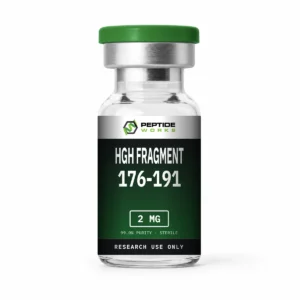
HGH Fragment 176-191 is a synthetic peptide made up of the last 16 amino acids of human growth hormone (somatotropin).

  • Synthetic peptide fragment
  • Somatotropin C-terminal fragment
01

Technical Overview

HGH Fragment 176-191 is a synthetic peptide made up of the last 16 amino acids of human growth hormone (somatotropin). The full hormone has 191 amino acids, but this fragment includes only the C-terminal part.

The peptide contains two cysteine residues capable of forming an intramolecular disulfide bond. This structural feature is relevant to investigations of peptide conformation and stability.

Laboratory analysis of HGH Fragment 176-191 focuses on its chemical identity, amino-acid composition and structural characteristics. Techniques such as high-performance liquid chromatography (HPLC) and mass spectrometry (MS) can provide information about chromatographic purity and molecular mass.

02

Chemical Classification

Chemical name
Human growth hormone fragment 176-191
Common names
HGH Fragment 176-191, hGH 176-191, HGH Frag
Alternative nomenclature
Somatotropin C-terminal fragment
Compound classification
Synthetic peptide fragment
Parent protein
Human growth hormone (somatotropin)
Peptide length
16 amino-acid residues
Molecular weight
1817.1 g/mol
Structural characteristic
Two cysteine residues capable of intramolecular disulfide bond formation
03

Molecular Characteristics

HGH Fragment 176-191 corresponds to the C-terminal region of human growth hormone. Its amino-acid sequence includes two cysteine residues that may form an intramolecular disulfide bond, restricting flexibility within part of the peptide.

The peptide’s chemical behavior depends on its amino-acid makeup, terminal groups, and structure. Factors like pH and solvent type can also affect its properties during lab analysis.

Although derived from human growth hormone, HGH Fragment 176-191 is chemically distinct from the complete protein. It also differs from related synthetic fragments, including AOD-9604, which is commonly described as containing an additional N-terminal tyrosine. Exact comparisons should account for the sequences and terminal modifications of the materials involved.

These distinctions matter when interpreting analytical findings or comparing growth hormone-derived peptides.

04

Mechanism Under Investigation

The specific molecular mechanism of HGH Fragment 176-191 has not been definitively established.

Research into growth hormone derived sequences looks at how different parts of the protein affect its structure and its biochemical properties. By looking at individual peptide fragments you can study the effect of particular sequences of amino acids without having to look at the whole protein.

However the presence of a sequence in human growth hormone doesn't in itself prove that the isolated fragment has the biological activity or receptor binding properties of the parent hormone.

Growth Hormone-Derived Sequence Research

Human growth hormone contains several structural regions that contribute to the conformation of the complete protein.

HGH Fragment 176-191 represents its C-terminal sequence. This makes it relevant to structural comparisons involving peptide length, amino-acid composition and molecular configuration.

Such comparisons can help distinguish the chemical properties of individual fragments. They do not, on their own, demonstrate equivalent biological activity.

Receptor Interaction Research

Full-length human growth hormone interacts with the growth hormone receptor through structural features of the intact protein.

HGH Fragment 176-191 lacks much of this molecular architecture. Receptor interactions established for the complete hormone therefore cannot automatically be attributed to the shorter peptide.

A definitive receptor target for the unmodified HGH Fragment 176-191 sequence has not been established. Proposed interactions require direct experimental confirmation using the specific peptide being investigated.

This summary reflects findings reported in published preclinical and in vitro research. The original studies supporting this information are listed in the references.

05

Experimental Research Areas

01

Sequence and Structural Research

HGH Fragment 176-191 contains a defined amino acid sequence that can be examined to better understand the chemical properties of growth hormone-derived peptides.

Researchers can compare peptide length, amino acid arrangement and terminal modifications to identify structural differences. Each of these features plays a part in determining a peptide's molecular identity, shape and behaviour during laboratory analysis.

Structure–activity relationships may also be considered when comparing related compounds. However, structural differences alone do not establish changes in biological activity.

02

Disulfide Bond and Peptide Conformation

HGH Fragment 176-191 contains two cysteine residues capable of forming an intramolecular disulfide bond.

Disulfide linkages can restrict peptide flexibility and influence the spatial arrangement of amino-acid side chains. Their presence and connectivity are therefore important considerations during structural characterization.

Analytical techniques, including specialized mass spectrometry methods, can be used to investigate disulfide connectivity in synthetic peptides. [1, 2]

The actual bonding configuration of a supplied sample should be confirmed through appropriate analytical evidence rather than assumed from its amino-acid sequence.

03

Peptide Stability and Degradation

Peptide stability is affected by temperature, pH, moisture and the surrounding chemistry.

For HGH fragment 176-191 the analytical studies look at changes in the chromatographic profile, molecular weight or structural integrity under controlled laboratory conditions.

Potential degradation processes are peptide bond cleavage, oxidation and alterations to the disulphide connectivity. The importance of any one of these will be dependent on the chemical nature of the peptide and the conditions under which it is stored or analysed. [3, 4]

Stability information from other peptides should not be treated as direct evidence of HGH Fragment 176-191 stability.

06

Analytical Verification

High-performance liquid chromatography (HPLC) can be used to assess chromatographic purity and detect potential impurities in synthetic peptide samples.

Mass spectrometry (MS) provides molecular mass information that can assist with peptide identification and the detection of certain structural variations.

Used together, these methods provide complementary analytical information. However, a single HPLC peak does not confirm peptide identity, and an intact mass measurement alone cannot establish the complete amino-acid sequence or disulfide connectivity. Additional analytical techniques may be required. [1, 4]

A Certificate of Analysis (COA) will contain the test results and reported specifications for a particular batch. It should be read in conjunction with the relevant supporting analytical data (HPLC, MS etc).

Certificate of Analysis
Batch20250917017
MethodCOA 2025
Document Download PDF
HPLC
Batch20250917017
MethodHPLC 2025
Document Download PDF
07

Storage & Handling

HGH Fragment 176-191 should be stored according to the conditions specified in its product documentation. Lyophilized material should remain sealed and protected from moisture, heat and unnecessary temperature fluctuations.

Supplied As Lyophilized Powder in Vial
Storage Store at 2–8°C
Handling Reconstitution Required
08

Questions researchers ask

HGH Fragment 176-191 is a synthetic 16-amino-acid peptide corresponding to the C-terminal sequence of human growth hormone. It is chemically distinct from the full-length protein.

For Research Use Only. Not for Human or Animal Use.

HGH Fragment 176-191 is supplied exclusively for laboratory research and analytical applications. The information provided is for scientific and technical reference only and does not constitute medical advice or guidance on administration, dosing, diagnosis, treatment or disease prevention.

Available now

HGH Fragment 176-191 Peptide from Peptide Works